PhyML 3.0
Overview: new algorithms, methods and utilities
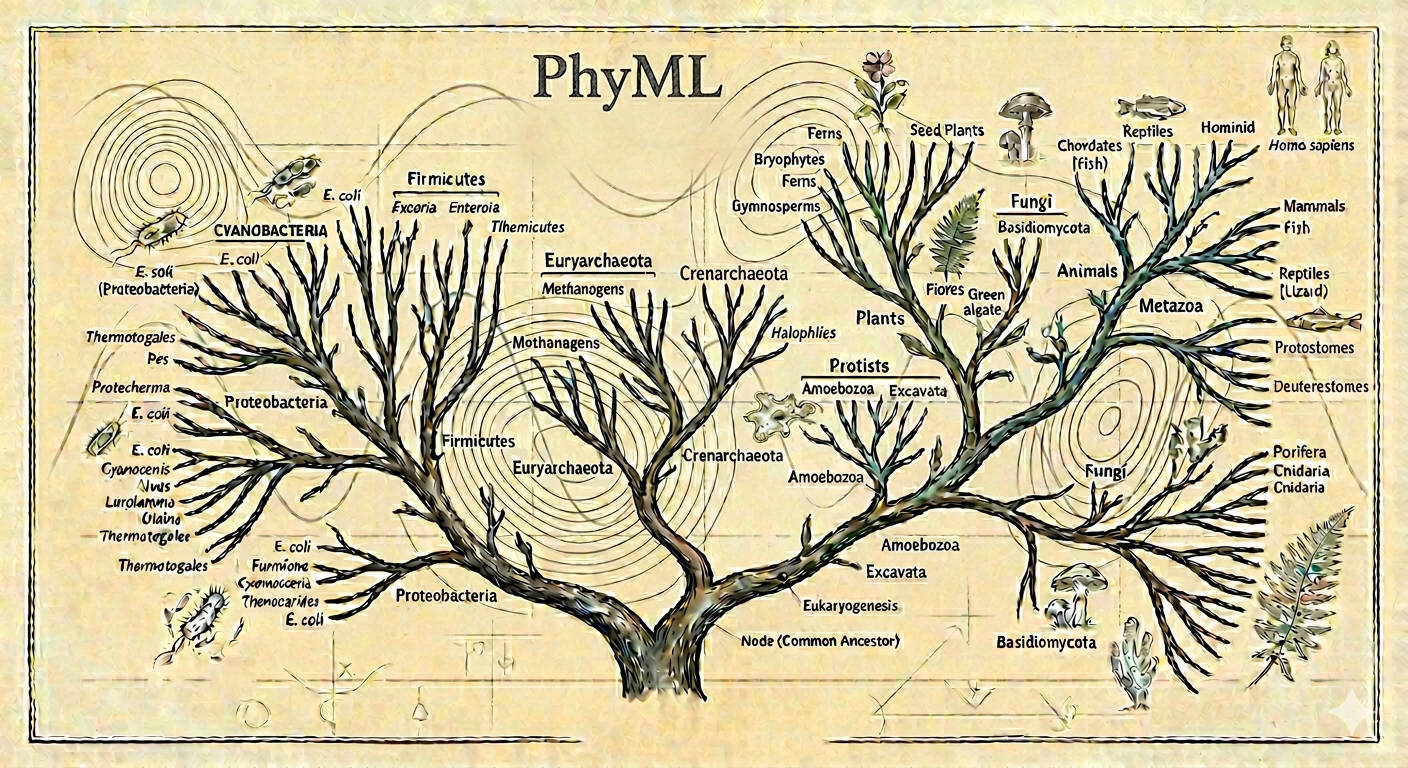
PhyML is a software package that uses modern statistical approaches to build phylogenetic trees from the analysis of alignments of nucleotide or amino acid sequences. The main tool in this package builds phylogenies under the maximum likelihood criterion. It implements a large number of substitution models coupled to efficient options to search the space of phylogenetic tree topologies.
Installation
To install PhyML, download the code from https://github.com/stephaneguindon/phyml/. After unpacking the archive, go into the phyml/ folder and type the following command:
sh ./autogen.sh;If you are using a Mac computer or running a Unix-like operating system, you will need to install the packages autoconf automake and pkg-config. On a Mac, the following command should set you up (provided Homebrew is installed on your Mac…): brew install pkg-config autoconf automake;
Next, to install any program that is part of the PhyML package, type the following commands:
./configure --enable-phyml;
make;
To compile a Windows executable, install MinGW and run:
./configure --enable-win --enable-phyml;
make;
To install the MPI version of PhyML, type the following commands:
autoreconf -i;
./configure --enable-phyml-mpi;
make;
PhyML 3.0 online execution
Other tools

DExTER
Overview DExTER (Domain Exploration To Explain gene Regulation) is a bioinformatics tool designed to automatically identify genomic regions whose nucleotide composition correlates with gene expression levels. Unlike traditional approaches focusing on short transcription factor binding sites (6-12 bp), DExTER detects Long Regulatory Elements (LREs) that can span tens to hundreds of nucleotides. This makes it…
EPIK
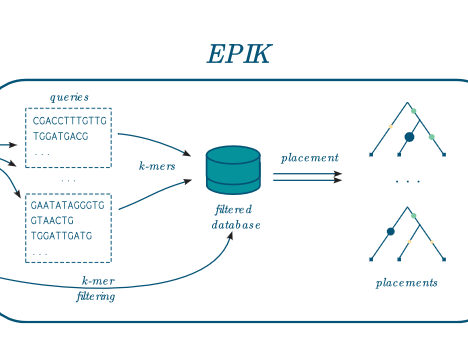
Precise and scalable evolutionary placement with informative k-mers EPIK is a program dedicated to « Phylogenetic Placement » (PP) of metagenomic or metabarcoding reads on a reference tree. It is similar in spirit and technically the successor of RAPPAS (Linard et al. 2020). EPIK achieves identical or slightly better accuracy than RAPPAS and outperforms it in speed and…

WAVES
Summary WAVES is a web application dedicated to bioinformatic tool integration. It provides an efficient way to implement a service for any bioinformatic software. Such services are automatically made available in three ways: web pages, web forms to include in remote websites, and a RESTful web services API to access remotely from applications. In order…