PhyML 3.0


Overview: new algorithms, methods and utilities

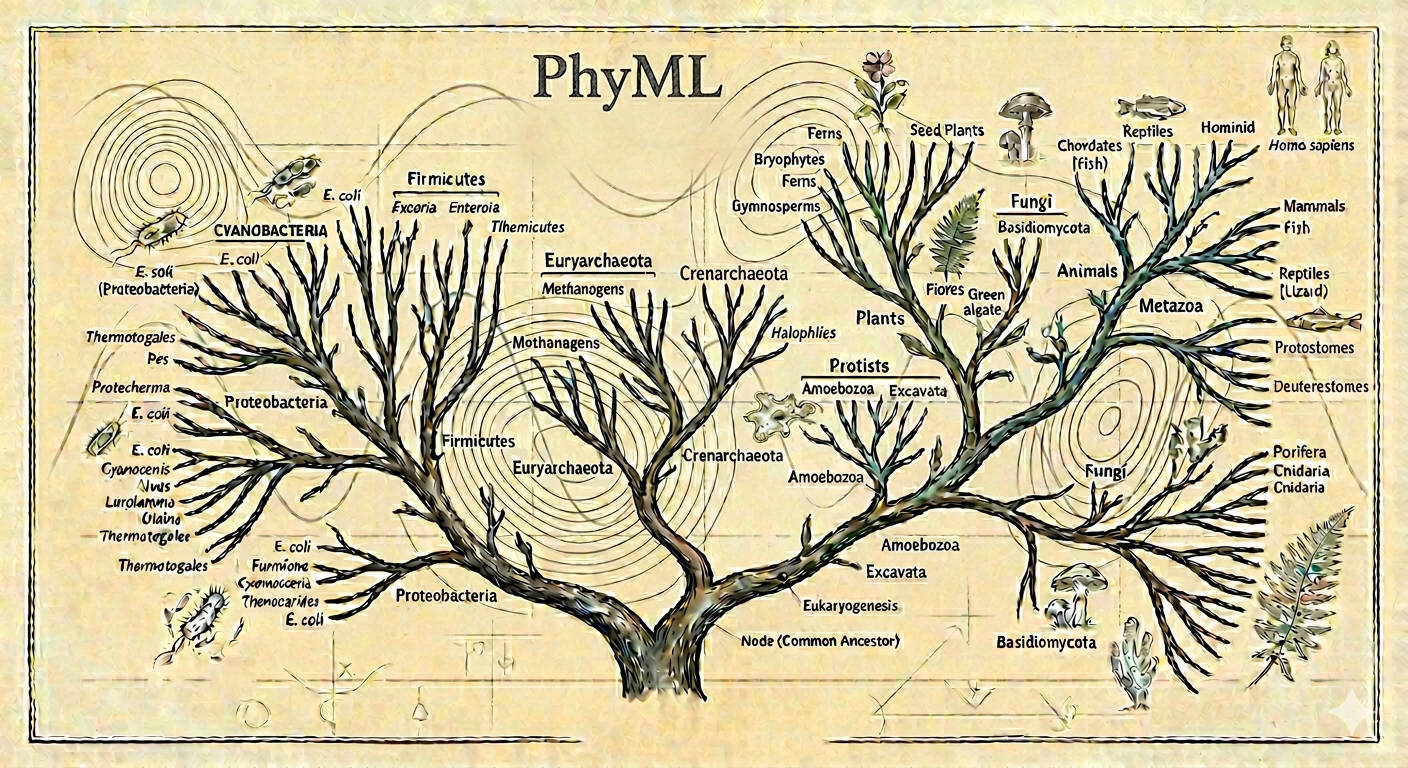
PhyML is a software package that uses modern statistical approaches to build phylogenetic trees from the analysis of alignments of nucleotide or amino acid sequences. The main tool in this package builds phylogenies under the maximum likelihood criterion. It implements a large number of substitution models coupled to efficient options to search the space of phylogenetic tree topologies.

Installation

To install PhyML, download the code from https://github.com/stephaneguindon/phyml/. After unpacking the archive, go into the phyml/ folder and type the following command:

sh ./autogen.sh;

If you are using a Mac computer or running a Unix-like operating system, you will need to install the packages autoconf automake and pkg-config. On a Mac, the following command should set you up (provided Homebrew is installed on your Mac…): brew install pkg-config autoconf automake;

Next, to install any program that is part of the PhyML package, type the following commands:

./configure --enable-phyml;
make;

To compile a Windows executable, install MinGW and run:

./configure --enable-win --enable-phyml;
make;

To install the MPI version of PhyML, type the following commands:

autoreconf -i;
./configure --enable-phyml-mpi;
make;

PhyML 3.0 online execution
Input data
Drag and drop a file or click to browse.
No file selected
Upload a PHYLIP formatted alignment file.
Select the type of characters contained in the alignment.
Substitution Model
Choose between automatic Smart Model Selection (SMS) or manual parameters.
Automatic model selection (SMS)
Criterion used by SMS to rank candidate models.
User defined model parameters
How equilibrium base or amino-acid frequencies are determined.
Choose whether to estimate the proportion of invariable sites.
Proportion of sites with zero substitution rate.
Specify how rate variation across sites is handled.
Number of discrete rate categories (for gamma models).
Choose whether to estimate the gamma shape parameter.
Shape parameter for the gamma rate distribution.
Substitution Model (DNA)
Substitution model applied to nucleotide sequences.
DNA transition parameters
Whether to estimate the transition/transversion ratio or use a fixed value.
Ratio of transition to transversion rates (DNA only).
Substitution Model (Protein)
Substitution model applied to amino-acid sequences.
Optimization options
Starting tree used to initiate the search.
User starting tree
Drag and drop a file or click to browse.
No file selected
Upload the custom starting tree in Newick format.
Optionally provide a tree to constrain the search space.
Constraint tree
Drag and drop a file or click to browse.
No file selected
Constraint tree in Newick format.
Random starting trees
Specify how many random starting trees should be generated.
Control whether tree topology is optimized.
Control whether branch lengths are optimized.
Add additional random starting trees to the search.
Branch supports
Fast branch support method.
Perform non-parametric bootstrap replicates.
Standard bootstrap settings
Specify the number of standard bootstrap replicates.
Transfer bootstrap settings
Specify the number of transfer bootstrap replicates.
Perform transfer bootstrap expectation analysis.
Extra options
Preserve duplicate sequences instead of collapsing them.
Output per-site likelihood values.
Infer ancestral sequences for internal nodes.

AQUAPONY

AQUAPONY

AquaPony: interactive visualization of phylogeographic scenarios AquaPony is a web application designed to explore and interpret evolutionary scenarios on annotated phylogenetic trees (for example, ancestral geographic states). It was built to make uncertainty in ancestral reconstructions easier to understand and communicate. Why AquaPony? In phylogeography, several scenarios can be nearly as plausible as the best…

CompPhy

CompPhy

CompPhy: a web-based collaborative platform for comparing phylogenies CompPhy is a web platform dedicated to the collaborative handling of phylogenetic trees. Users can freely manage collections of trees and communicate on a common project. By collaborative, we mean that several users connected to the same project can manipulation at the same time trees from shared…

Data visualisation Phylogenomics Phylogeny Phylogenetic analysis Phylogenetic sub/super tree construction Phylogenetic tree editing Gene tree newick Nexus format
TIDE

TIDE

What is TIDE? TIDE is the orchestration platform behind ATGC online bioinformatics services. It provides a unified web interface and a public REST API to submit analyses, monitor jobs, and retrieve results across a growing catalog of phylogenetic and sequence-analysis tools. TIDE is a modernized redesign of WAVES, an older tool previously developped by ATGC…

Sequence analysis Software engineering Service discovery Service invocation Service management Job identifier Tool metadata HTML JSON
⚠️ This website is under construction, some information or links could be unavailable ⚠️